
The History Of Havn County
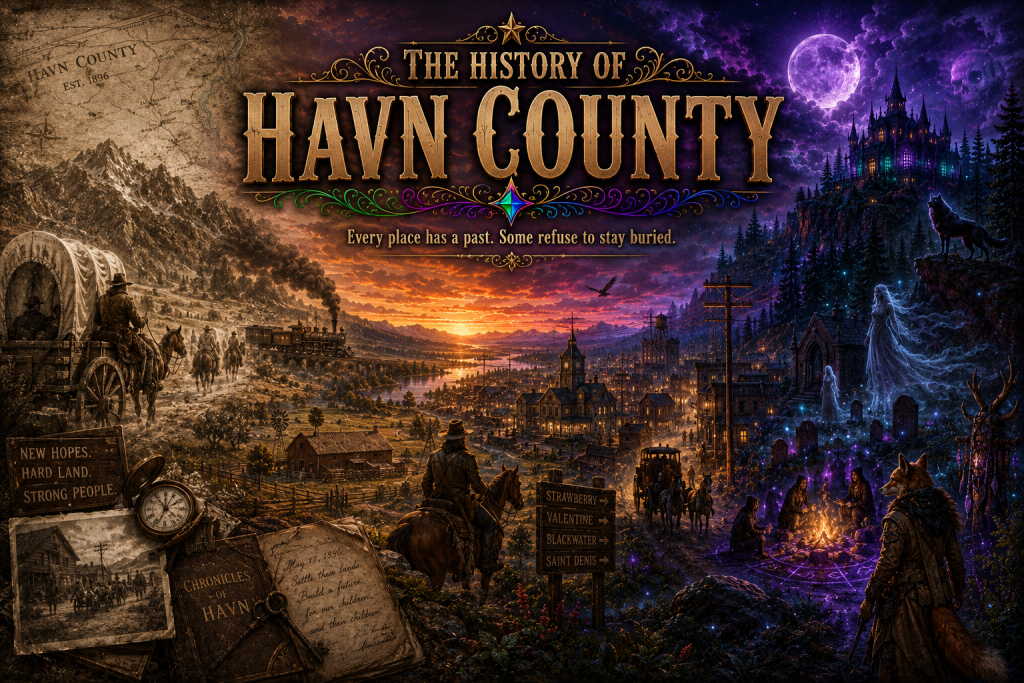
The History Of Havn County
No official survey ever agreed on when the county first appeared on a map.
Some claim it was always there — a vast and untamed expanse of the western frontier that resisted definition. Others insist it emerged quietly between ink strokes and ledger lines, slipping into existence where borders were weakest and certainty wore thin.
What is known is this: the county is different.
It stretches wide and strangely, a land of deep forests, open valleys, worn stone, and places that feel older than the country built around them. The weather behaves oddly here. Paths shift. Time sometimes feels softened at the edges, as if the land itself is listening rather than marching forward.
The county has a reputation — though no one agrees how it earned it — as a place of shelter.
People arrive from everywhere. Indigenous peoples whose roots run deeper than memory. Immigrants drawn across oceans by rumor, dream, or desperation. Settlers, drifters, scholars, laborers, and the quietly lost. Some come chasing opportunities. Others are running from histories that refuse to loosen their grip.
Many never intended to stay.
Most do.
There is something about the land that calls — not loudly, not violently, but persistently. Like a hand at your back during a storm. Like warmth when the night should be colder. Those who listen say the county knows who needs it.
And it does not stop at human souls.
Creatures spoken of only in myth have been known to wander its borders and settle in its hidden places. Old gods and forgotten goddesses — displaced, diminished, or merely tired — have found refuge here, along with the remnants of cultures that once worshipped them. Shrines sit beside farmhouses. Ancient rites coexist with church bells. Faiths thought lost to history quietly endure.
Not all who arrive understand what they are stepping into.
Scientists come to study anomalies they cannot publish. Historians chase records that contradict themselves. Doctors misdiagnose what they cannot explain. Poets, artists, and wanderers feel something open in their chests and never quite leave again.
The county does not promise peace.
But it offers harbor.
It is a place where the strange may rest without being hunted, where belief does not require permission, and where survival — human or otherwise — is not an act of defiance, but a shared agreement.
Those who stay learn one truth quickly: The county does not belong to its people. The people belong — for a time — to the county.
Name Origin Of Havn County
- From Norwegian “havn” — meaning harbor, haven
- Calm, grounded, a place of arrival and rest
- A harbor at the edge of the wild where all roads end.
©Havn County